By Prerna Kapoor, CLHMS | REAL Brokerage | July 5, 2026
A buyer called me last month convinced she had to waive her inspection contingency or she would never win a house in Highlands Ranch. She was half right. The market has been competitive enough this year that waiving inspection contingencies has become common again, but “common” and “right for you” are two different questions, and I want to walk through both sides honestly before you decide.
Here’s what the inspection contingency actually does, why buyers are giving it up, and the middle-ground options most people never hear about from a listing agent.
What the inspection contingency actually protects you from
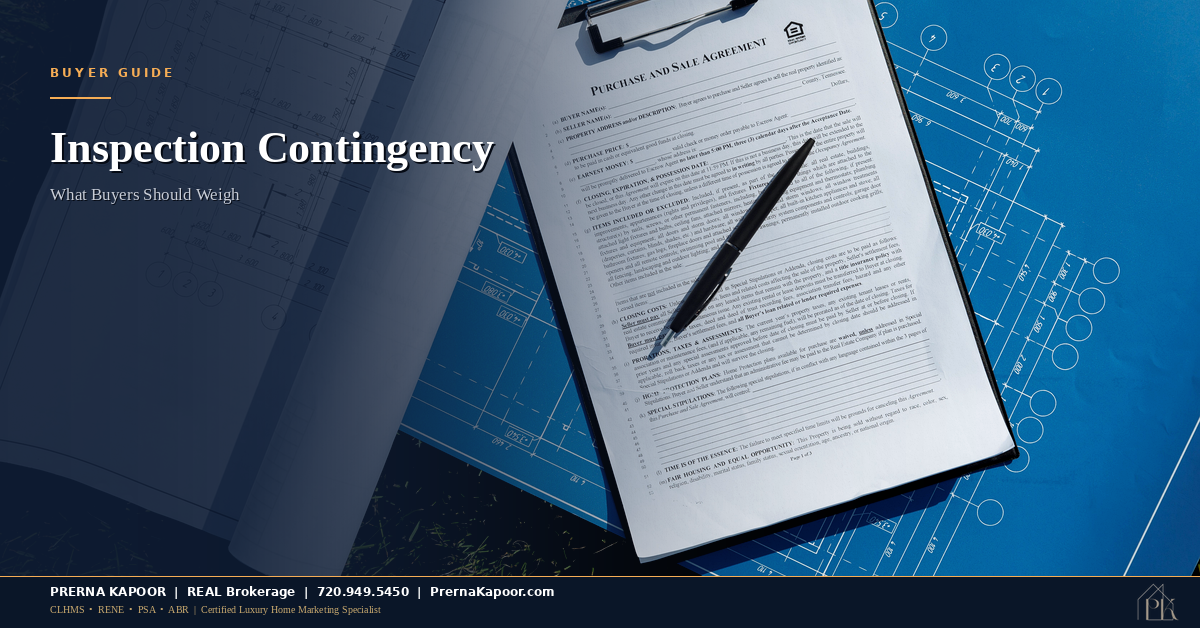
A standard Colorado contract gives you a set number of days, typically 8-10 in most transactions I write, to have the home professionally inspected and either walk away, ask for repairs or a credit, or move forward as-is. Without that contingency, you’re buying the house exactly as it sits on closing day, cracked foundation, failing furnace, hidden roof damage and all, with no contractual right to renegotiate or exit over what the inspection finds.
That’s a real risk. A foundation issue alone can run into five figures, and a lot of the systems that fail expensively, furnace, water heater, sewer line, don’t show any symptoms from the outside of a house.
Why buyers are choosing to waive it anyway
Get the Free Colorado Buyer Guide
Prerna's no-fluff buyer playbook, built from real Colorado closings. Straight to your inbox.
No spam, ever. Unsubscribe anytime.
In a multiple-offer situation, a clean offer without an inspection contingency is genuinely more attractive to a seller than an equal or even slightly higher offer that keeps one. Sellers read it as fewer chances for the deal to fall apart in the final stretch, and this year I’ve watched inspection-contingency waivers show up in nearly every winning offer on well-priced homes under $650,000 in Parker and Aurora. That’s not a national statistic, it’s what I’ve personally seen come across the table in my own transactions this spring and summer.
The tradeoff is real: waiving the contingency can be the difference between winning and losing a house you actually want. It just shouldn’t be automatic.
The middle ground most buyers don’t know exists
You don’t have to choose between a full contingency and no protection at all. A few options I use regularly with clients:
Pre-offer inspection. Schedule your own inspector to walk the house before you write the offer, with the seller’s permission. You still waive the contract contingency, but you’re not walking in blind.
Information-only inspection. You keep the right to inspect, but give up the right to ask for repairs or credits. You can still walk away if something is seriously wrong, you just can’t negotiate over minor issues.
Limited-scope inspection. Waive the general home inspection but keep a sewer scope or radon test. These are the two issues most likely to be expensive and invisible, and they’re the ones I recommend clients protect against even when everything else gets waived.
What I tell my own clients before they waive anything
I don’t tell clients whether to waive the contingency. That’s their decision, and it depends on their risk tolerance, their cash reserves, and how much they want the specific house. What I do is make sure they understand exactly what they’re giving up before they decide, and I push for a pre-offer inspection or a sewer scope whenever the schedule allows it. A rushed decision made out of fear of losing the house is a worse outcome than a slower decision made with real information.
Quick answers
Is waiving the inspection contingency ever a bad idea? It’s a bad idea when it’s done reflexively out of fear rather than as an informed tradeoff. A pre-offer inspection or limited-scope inspection often gets you most of the protection without weakening your offer.
Can I still get a home inspection if I waive the contingency? Yes, in most cases you can still have the home inspected for your own information. You’re only giving up the contractual right to negotiate or exit based on what it finds.
What should I never waive? A sewer scope and radon test are the two I recommend keeping in almost every situation. Both check for problems that are expensive to fix and impossible to see with the naked eye.
If you’re weighing whether to waive an inspection contingency on a specific house, I’m happy to talk through the actual condition of that property and what makes sense for your situation. My look at Colorado’s return to bidding wars covers more of what’s driving buyers to waive contingencies right now, and my walkthrough of what a home inspector actually checks is worth reading before you decide either way.
Prerna Kapoor | REALTOR® | Luxury Home Specialist
REAL Brokerage | 720-949-5450 | info@prernakapoor.com
CLHMS • RENE • PSA • ABR | International Sterling Society Award Winner
Prerna specializes in residential real estate across Parker, Aurora, Lone Tree, Castle Pines,
Highlands Ranch, Cherry Creek, Greenwood Village, and Centennial. She speaks English, Japanese,
and Hindi.