By Prerna Kapoor, CLHMS | REAL Brokerage | August 20, 2026
Almost every buyer I work with says some version of the same thing early on: “we want to be close to Denver.” It’s a completely reasonable starting point, and it’s also not specific enough to actually plan around. Close to Denver for a job at the Denver Tech Center is a different commute than close to Denver for a job downtown, and the neighborhoods that win on one can lose on the other.
I’ve watched enough buyers assume “30 minutes on Google Maps” settles the question, then move in and discover their real commute looks nothing like that number. So here’s an honest comparison of what commuting actually looks like from Parker, Aurora, Lone Tree, Highlands Ranch, and Centennial, including the part most people skip: whether you have a real light rail option or you’re stuck on the highway no matter what.
“Close to Denver” Means Two Different Things
The Denver Tech Center, sometimes shortened to DTC, is its own major employment hub straddling Denver, Greenwood Village, and unincorporated Arapahoe County along I-25 south of downtown. It’s a huge share of the corporate, tech, and financial jobs in the metro. Downtown Denver, further north, is a separate commute with its own traffic pattern. If your job is in the DTC, Lone Tree and Highlands Ranch can genuinely feel close. If your job is downtown, that same drive gets meaningfully longer, and the calculus changes.
This is the first question I ask every relocating buyer: where do you actually work, DTC or downtown, or somewhere else entirely like the Anschutz Medical Campus in Aurora or the airport corridor? The answer changes which suburb makes the most sense before we even look at a single house.
What the Drive Actually Looks Like, Area by Area
Get the Free Colorado Buyer Guide
Prerna's no-fluff buyer playbook, built from real Colorado closings. Straight to your inbox.
No spam, ever. Unsubscribe anytime.
Lone Tree and Highlands Ranch sit closest to the DTC. Via I-25 and C-470, that drive typically runs in the 15 to 25 minute range outside of rush hour, which is about as short as a South Denver suburb commute gets to that particular job hub. Getting downtown from either city adds real time, since you’re fighting the same northbound I-25 traffic everyone else is trying to use.
Centennial and Greenwood Village overlap the DTC directly or sit right against it, so for DTC-based jobs, some Centennial neighborhoods have close to the shortest commute on this list. Aurora’s access runs through I-225, which connects DTC, the Anschutz Medical Campus, and Denver International Airport without ever touching downtown I-25 congestion, which is worth knowing if you work in healthcare or aviation rather than a traditional office job.
Parker is the furthest out geographically, and it shows in the numbers. Parker Road (CO-83) and E-470 get you to I-25, but the DTC commute typically runs closer to 25 to 35 minutes outside rush hour, and downtown adds more on top of that. What Parker buyers are usually trading for that extra drive time is larger lots, newer construction, and price per square foot that goes further than it does closer in. That’s a legitimate trade, but it should be a conscious one, not a surprise six months after closing.
Do You Actually Have a Light Rail Option?
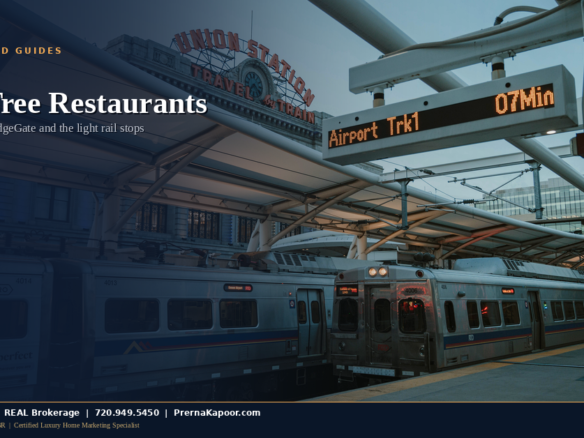
This is the part that gets skipped the most, and it shouldn’t be. RTD’s Southeast Corridor, served by the E and R light rail lines, runs stations at Dry Creek and County Line in the Centennial and Lone Tree area, plus Lincoln, Sky Ridge, Lone Tree City Center, and RidgeGate Parkway further south in Lone Tree. According to RTD’s own route information, these stations connect straight up the Southeast Corridor into the DTC and continue toward downtown Denver, with park-n-ride capacity at several stops.
Practically, that means a Lone Tree or Highlands Ranch buyer near County Line or RidgeGate Parkway has a real park-and-ride alternative to driving every day, not just an emergency backup. Parker doesn’t have its own light rail station, so a Parker resident who wants to use the train is driving to one of those Lone Tree stations first, which is worth factoring in if a car-free or car-light commute matters to you.
Rush Hour Changes Everything, and Google Maps Undersells It
The number Google Maps shows you by default is often the off-peak or “typical” time, not what you’ll actually experience leaving at 7:45 on a Tuesday. CDOT’s own congestion data consistently shows I-25 through the DTC corridor and the C-470/I-25 interchange as some of the most congested stretches in the state during weekday peak hours, and that stretch touches nearly every commute on this list at some point.
If a home you’re considering looks great on paper, don’t stop at the map estimate. Drive the actual route at the actual time you’d be commuting, ideally both directions, before you write an offer. I’ve had clients who loved a home on a Sunday afternoon showing and were shocked by what the same drive looked like on a Monday morning. It’s a 20 minute investment that can save you a genuinely miserable daily routine.
What I’d Actually Ask Yourself Before Choosing a Suburb on Commute Alone
Where’s the job today, and is it likely to move? A lot of companies have shifted DTC-based teams closer to downtown or gone hybrid in the last few years, which changes the math on a purely commute-driven decision. Would you actually use light rail if it were an option, or is that more of a nice-to-have you won’t use twice a month? And how much extra drive time are you genuinely willing to trade for lot size, school boundaries, or price per square foot, because for most of my clients, commute ends up being one factor weighed against several others, not the only one that decides it.
If you’re comparing specific suburbs head to head beyond just commute, my Parker vs. Castle Rock vs. Lone Tree comparison walks through more of those trade-offs, and my neighborhood evaluation guide covers the fuller list of objective factors worth weighing beyond drive time. If Lone Tree specifically is on your list, I go deeper on what living there actually looks like in my Lone Tree living guide.
Quick answers
Which South Denver suburb has the shortest commute to the Denver Tech Center?
Lone Tree, Highlands Ranch, and Centennial are typically the shortest, since several Centennial and Greenwood Village neighborhoods sit directly against the DTC. Parker is the furthest out geographically and usually has the longest DTC and downtown commute of the group.
Does any South Denver suburb have direct light rail access?
Yes. RTD’s Southeast Corridor E and R lines serve Dry Creek and County Line stations near Centennial and Lone Tree, plus Lincoln, Sky Ridge, Lone Tree City Center, and RidgeGate Parkway further into Lone Tree. Parker does not have its own station, so Parker residents drive to one of those stops to use the train.
Should I trust Google Maps’ commute estimate when I’m house hunting?
Treat it as a starting point, not the final answer. It often shows off-peak timing rather than actual rush hour conditions. Drive the real route at the real time you’d be commuting before making an offer, especially along the I-25/C-470 corridor, which CDOT consistently flags as one of the state’s more congested stretches.
Prerna Kapoor | REALTOR® | Luxury Home Specialist
REAL Brokerage | 720-949-5450 | info@prernakapoor.com
CLHMS • RENE • PSA • ABR | International Sterling Society Award Winner
Prerna specializes in residential real estate across Parker, Aurora, Lone Tree, Castle Pines,
Highlands Ranch, Cherry Creek, Greenwood Village, and Centennial. She speaks English, Japanese,
and Hindi.